
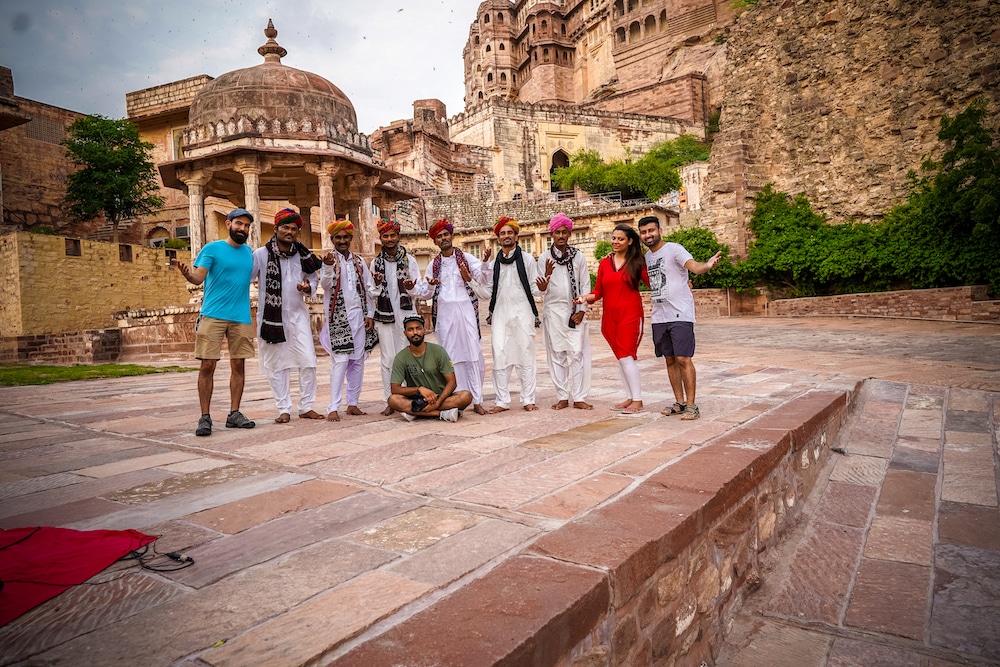
Jodhpur, often referred to as the Blue City, is one of Rajasthan’s most enchanting jewels. It stands resplendent under the watchful eye of the mighty Mehrangarh Fort, a structure that has seen centuries of history unfold. Amidst its sun-soaked streets and vibrant bazaars lies a treasure trove of culture, music, and tradition. It was in this magical setting that we met a group from the Langha community led by the ever-enthusiastic Ayub Khan. This encounter revealed not just a performance but an entire legacy carried through their voices and instruments—a tale of song givers from the heart of Rajasthan.
The Langhas, a tribal community of Rajasthan, are spread across regions like Jodhpur, Phalodi, and Udaipur. Known as ‘song givers,’ they are extraordinary performers whose music is deeply rooted in the cultural and emotional fabric of their people. Their songs are a beautiful ode to life, resonating with themes of love, romance, weddings, and devotion to God. For centuries, these melodies have echoed through the desert sands, binding communities together and passing stories from one generation to the next.
We set up a recording for Ayub Khan’s group in a stunning haveli, an ancient mansion that seemed to breathe history through its carved archways and elegant courtyards. The setting was extraordinary, but when the Langhas began to play, the haveli came alive, its walls reverberating with the soulful sounds of their instruments and voices. For those few hours, time seemed to stand still.
Langhas are virtuosos of two prominent instruments: the Sindhi Sarangi and the Algoza (a double flute). These instruments are an inseparable part of their musical identity, accompanying songs that weave tales of joy, sorrow, and celebration.
The Sindhi Sarangi is an especially fascinating instrument. Made of seasoned teakwood, it consists of four main strings and over twenty vibrating sympathetic strings, creating its haunting, resonant tones. It takes immense skill and precision to play, as the musician must bring out the instrument’s soulful sounds while syncing with its intricate structure. To enhance the rhythm, the bow is often adorned with ghungroos (ankle bells) that create a rhythmic jingle as the sarangi is played.
The Algoza adds another dimension to their music. Played with incredible lung power and coordination, this double flute is often used to accompany folk melodies. Its sound mimics the rustling desert winds and whispers of ancient tales, transporting listeners to the heart of Rajasthan’s desertscape.
When Ayub Khan’s group began their performance, the music wasn’t just heard—it was felt. Their songs belong to the Khamai, Maru, Kilad, and Des raag families, classical frameworks that underpin much of Rajasthan’s folk music. These melodies have survived for generations, a testament to the Langhas’ deep reverence for their cultural roots.
Ayub Khan explained that their songs are not of their own creation; they are inherited legacies, passed down orally over centuries. Each note, each word carries the weight of their ancestors’ lives and stories. Despite their hardships, the group sings with unbridled passion and humility. “We wish to sing these songs forever,” Ayub said, “money doesn’t matter to us.”
To illustrate his sentiment, he began singing a song that beautifully captures the Langhas’ connection to their craft and culture:
Charkho Chandan kaathro
The spin yarn is made out of sandalwood
Puni lal gulal
The threads in it are of different colors
Katwari kaatan baithi kaatyo ant na paar
And made a beautiful shawl with those threads
Ho bhala re jio bhala re
May God bless you with a long life
Bhue charkha bhu
Praise the spin yarn
The song, though simple in words, holds profound meaning—a metaphor for life’s delicate yet enduring threads that bind us all. It exemplifies the Langhas’ ability to find beauty in simplicity and turn it into a profound artistic expression.
While their music holds immense cultural value, the Langha community faces challenges in sustaining their art. Traditionally, they perform at weddings, births, and other festive occasions, often exclusively for their patrons. During peak seasons, Ayub Khan’s group manages to secure 8-10 shows, earning approximately ₹7000-₹8000 per performance. However, this income is inconsistent, and opportunities can be scarce during off-seasons.
Despite these challenges, the group has performed in major cities across India, and their dream is to take their music to every corner of the country. They hope to one day have a large band and perform in front of massive audiences who appreciate their traditional songs. Their aspirations are not rooted in fame or fortune but in the desire to keep their music alive and relevant for future generations.
“We want the world to hear our songs,” Ayub shared, his voice filled with hope. “If we can inspire even one person to preserve this tradition, our work will be worth it.”
Currently, show bookings come through local contacts who forward opportunities for performances both in India and abroad. Yet, there remains a need for greater visibility and platforms that can bring these talented artists to the forefront.
Ayub Khan and his group represent not just the Langha community but also a larger narrative of India’s folk traditions, which often remain underappreciated. Their music carries the soul of Rajasthan, resonating with stories that have shaped communities for generations. By giving them platforms and recognition, we do more than preserve an art form—we ensure that the voices of these song givers echo through time.
As the final notes of their performance rang through the haveli, a profound silence settled in—the kind that comes when something truly magical has just taken place. The Langhas had once again proven that music is more than entertainment; it is a gift, a bridge between past and future, between hearts and souls.
Their dream is simple but powerful: to sing forever, to give the world the tales carried in their songs, and to ensure that the threads of their musical heritage remain unbroken. For the Langhas, music is not just an art—it is life itself.
And in the land of songgivers, life will always find a way to sing.


