
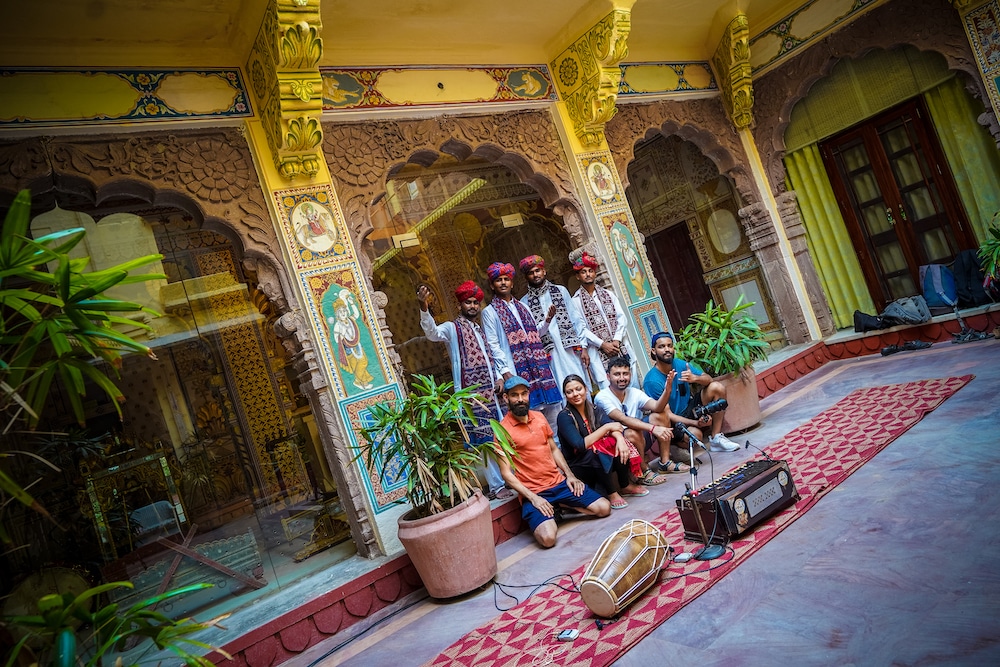
Jodhpur has a vibe which can not be compared with any other place. Searching for a place to sit and relax we came across Sanu and his group in Mehrangarh Fort. Seeing us he greeted us with a song:
Dhann dhann bhaage banno re
The groom is running around with happiness
Aree Sawa aage banni laderlo re
Let’s welcome the procession, it has arrived
Dhann moh tan kedi re maya re
Money and wealth nothing matters
Heli Aayo re heli mori laderlo amraano
My beloved groom has come to Amar Kot
Pe nigare sa raaje
Lift your feet and come
Auto bhaaye pyaaro re banna
The groom is looking so handsome
Areey Jaanida shringar laaderlo re
Dress up the procession beautifully
Jaanida ri jode hey banide
All walk together
They come from the Langha community of musicians who play Sindhi Sarangi and Algoza very fondly. Their music filled with magical voices is very different from usual Langha community music. They often perform at various occasion which varies according to the life events of their patrons which happens to be the royal family of that particular area. The Sarangi used by this group was not the usual type we often encounter with. It had four main wires with twenty vibrating sympathetic strings that helps in creating the mesmerising music. One can find more about the langhas with their visit to Jodhpur, Phalaudi, Udaipur, etc. Music is the only source of livelihood for them. In future, they want their children to be trained in music but along with an academic inclination as well. During peak seasons, their group gets 2-3 offers to perform every month and earns as much as Rs.50,000 for each show. The songs of their group encompass a wide range of themes deep rooted in Rajasthani traditions. They get shows mostly because of their contacts. They are very well-aware of Anahad’s role and work in empowering folk musicians. The group sings songs about love, romance, different timelines of weddings, etc. On asking about their favourite song they started singing :
Khaatireda oh ji re baitha tu to maare chuttare o ji ree
Khaati’s son is sitting and he is looking very beautiful
Sidhone …Ghaniya re gholi jaaun
He looks so beautiful, may he is safe from all evil eyes
Taraniyo re ghar lawa oh ji more
Bring the decorate flowers to my house
Chandane kedo re rukhero
It should be like sandalwood
Re rukhero oh ji re rukhero re mora raj
Oh King, bring me a tree of Sandalwood
Aundene utariyo maaro gaddo maaru sawari re ada beech
Come on a horse and get down at my house
Ghaniya re gholi jaaun
meri nazar na lag jaae kahin
Sanu and his group are so happy with their musical lives that they never see their problem as any obstacle in their lives. The strength they get in their daily life to face adversities is from their music. Sanu wants to open a folk learning music school in his village and wishes to enrol next generation there free of charge to promote their culture.