
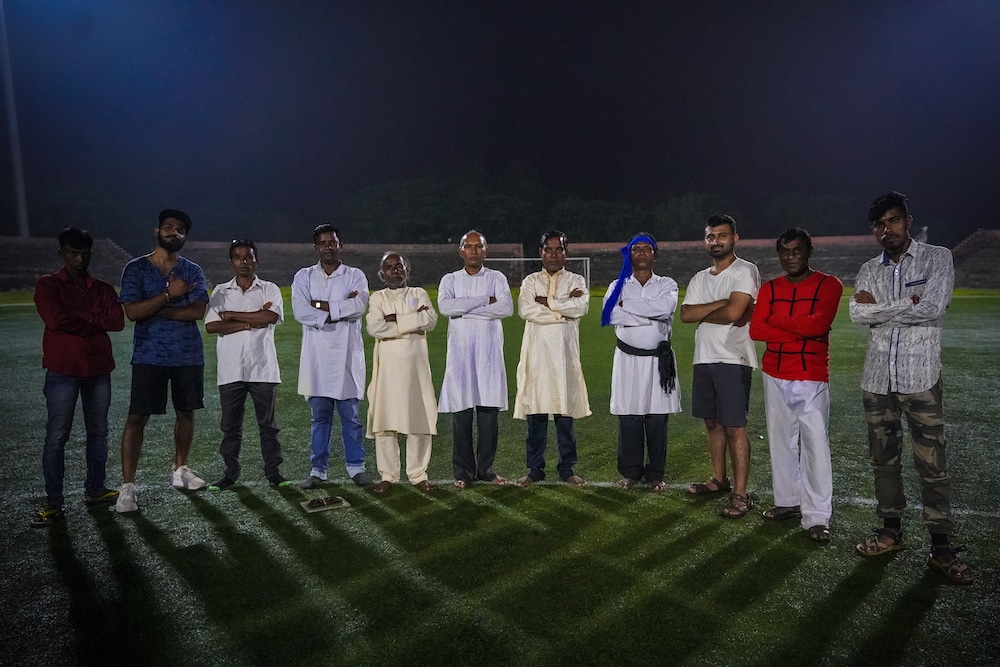
Far away in the heart of India, in the rolling green landscapes of Jharkhand, a group of passionate artists carries forward an age-old tradition that resonates with joy, rhythm, and nature’s bounty. These are the custodians of Jhumar, a traditional folk form that finds its roots in the harvest season. Once sung and danced to in celebration of monsoon blessings, Jhumar is now performed year-round, gracing weddings, festivals, and grand celebrations.

Jhumar is more than just a dance—it is a story of life, community, and connection to the land. Originally performed between August and September, during the harvest season, the folk form encapsulates the happiness and unity of the tribal communities. The vibrant rhythms, soulful melodies, and intricate dance movements make Jhumar a feast for both the eyes and the ears.

The performance setup itself is enchanting. Adorned in colorful traditional attire, the artists radiate energy and emotion. The rhythmic beats of instruments like the Mandar, Dhol, Flute, Nagara, Dhak, Shehnai, and Khartal bring the stories alive, captivating audiences of all ages.

As Kartik Koiri, the group leader, explains, Jhumar has evolved over the years and is no longer confined to a single season. Today, it is performed during weddings, religious festivals, and other significant occasions, adapting beautifully to the needs of modern times.

The folk form also has various styles, including Khortha Jhumair, Nagpuri Jhumair, and Kurmali Jhumair. Within Nagpuri Jhumair, there are further distinctions, such as Mardana Jhumair, performed by men, and Janani Jhumair, where women join the performance. Janani Jhumar, in particular, brings a unique charm, as the inclusion of female dancers adds a delicate grace to the art form.

Kartik, an exceptional flute player and a visionary artist, believes in keeping the tradition alive by evolving it. He writes many of the songs himself, tailoring them to the seasons and occasions they celebrate. His dedication ensures that the essence of Jhumar remains intact while resonating with contemporary audiences.

When Kartik met the team from Anahad, his excitement was palpable. Anahad’s vision to conserve and celebrate India’s rich folk music aligned perfectly with Kartik’s own dreams. He expressed the urgent need to preserve art forms like Jhumar, which are not just performances but living narratives of a culture deeply rooted in its people and their connection to nature.

After sharing his thoughts, Kartik began singing a poignant hymn:

Aago maata bina paani tumhi maa jagat janni
(Oh Goddess Mother Earth, you are the life-giver of this land)

Gyaan hino achir tomar charne
(The boy with no knowledge bows at your feet)

The melody filled the space, echoing with devotion and reverence for the earth. It was a moment that reminded everyone present of the powerful connection between folk music and spirituality.

The beauty of Jhumar lies in its ability to evolve while staying true to its roots. It reflects the joy of the monsoon rains, the hard work of farmers, and the unity of communities celebrating their shared heritage. In Kartik’s group, every member plays an essential role in bringing this art form to life.

The performances are not just artistic expressions but celebrations of life itself. The energy, precision, and emotion that Kartik and his group bring to each performance ensure that audiences are transported to a world where tradition and joy merge seamlessly.

Kartik dreams of taking Jhumar to national and international platforms, showcasing its vibrancy and significance to wider audiences. He believes that by sharing this tradition with the world, they can inspire others to appreciate and preserve their own cultural roots.

The collaboration with Anahad has strengthened this vision, providing hope that with collective efforts, folk traditions like Jhumar will continue to thrive, connecting generations and bridging cultural gaps.

Jhumar is not just a folk art form; it is a celebration of life, a tribute to the earth, and a reminder of the unity and happiness that lie at the heart of human existence. Kartik Koiri and his group stand as torchbearers of this tradition, keeping its melodies alive in a world that often forgets to pause and listen.

Their performances, stories, and passion are an invitation to all of us to reconnect with the rhythms of the land, to celebrate the simplicity of life, and to preserve the treasures of our cultural heritage for generations to come.