
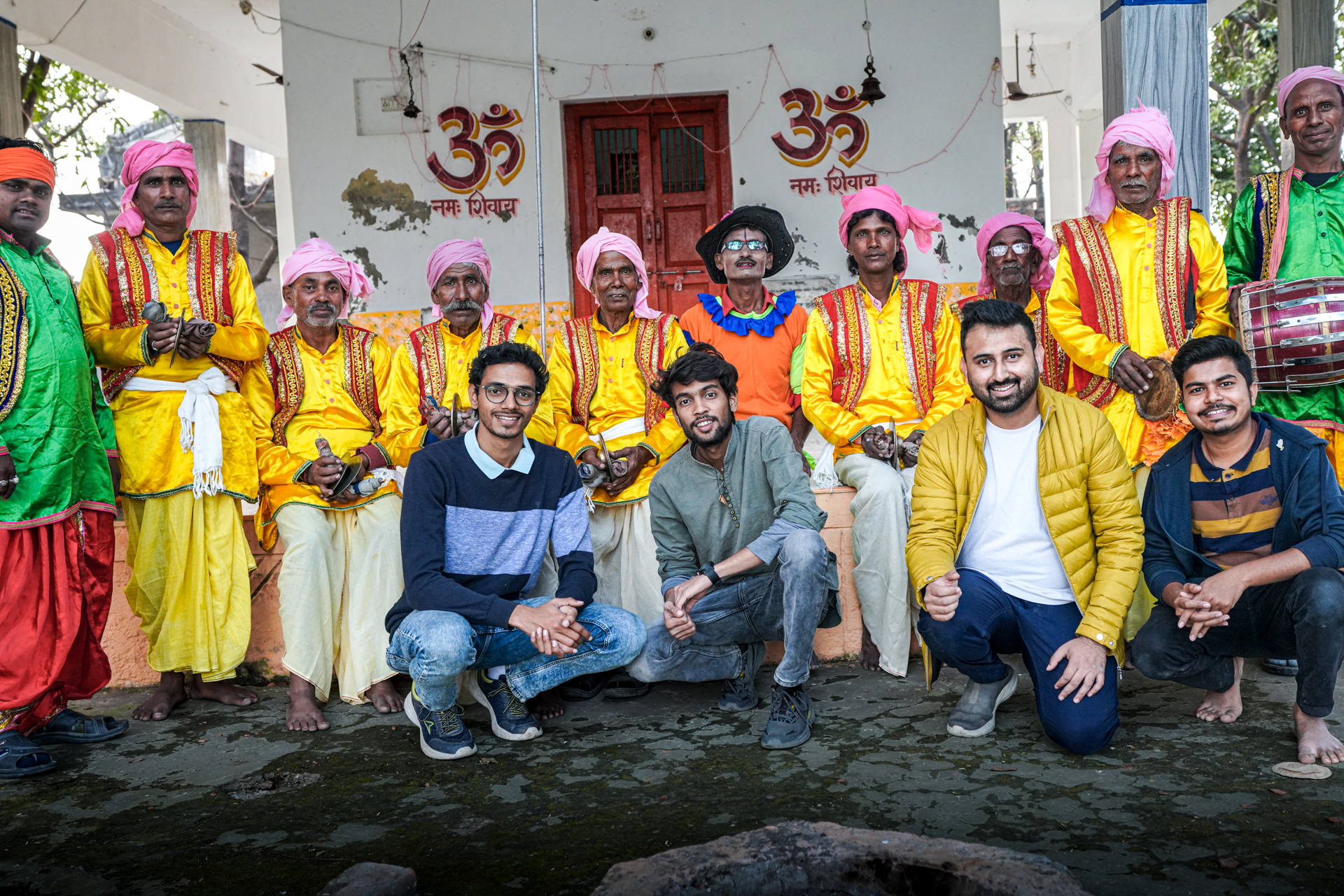
The joker who sings and dances to Huduk
The Huduk is a unique percussion instrument whose energetic beats form the base of Godau dance.
Several folk forms are specific to a particular tribe or jati, a community that has traditionally performed it, and they claim it as their cultural heritage. Most commonly, these folk forms also tend to be associated with the occupation of the jati and serve as a peek into their way of life and their customs and beliefs. Uttar Pradesh has many such jatis, each of which has its unique folk form and is performed in the dialect of Hindi spoken in that region. One such folk form is Godau Naach, the traditional folk form of the Goud people, a community of people that participated in the trade of grains.
Godau dance is similar to a few other jati-specific folk forms like Dheemariya, Ahiriya and Kaharwa, all of which employ the percussion instrument called Huduk and involve rhythmic dance to the beats. These dances, though, differ in the costumes and dance steps. For instance, Dheemariya is notable for using ghungroos tied on the waists. Godau dance is performed by a dancer who sings while performing and wears outlandish costumes to catch the audience’s attention.
Abhiraj belongs to the Azamgarh district of Uttar Pradesh and is from the Goud community. His father was also a Godau singer and dancer. His father started the dance group and managed it all his life. Upon the demise of his father, the group was on the verge of closing down because nobody was willing to work it. Abhiraj stepped in not only to continue the group in his father’s memory but also to continue the tradition of his community. Today, his group is the only Godau dancing party in his district.
The Goud people historically performed Godau dance on occasion and at gatherings of the Prajapatis, the landlord jati. The dance served as entertainment for the guests and was performed all night. The songs can be about anything, so long as they are performed to a specific tune. It is an energetic tune where each stanza ends with the Hudka beats to which they dance. Abhiraj’s dance group typically performs the songs in the rural dialect of Hindi, called khari boli, or in Purbi, a dialect of Hindi that borrows heavily from Awadhi. The songs are based on mythology and the epics of Ramayana and Mahabharata. Abhiraj doesn’t encourage his group to perform film songs or other mass entertainment songs and instead sticks to their traditional folk-art forms.
Kaharwa is a dance form that is also closely related to Godau and is the traditional dance of the Kahar community, who were the palanquin bearers in the olden days. Kaharwa has become fashionable and is in great demand at weddings and other events. Owing to this demand, Abhiraj has incorporated Kaharwa dance also into the group’s performances, and the group is now called “Godau-Kaharwa Dance Party.” They have performed in many places across Uttar Pradesh, including Allahabad and Varanasi and have even completed once in Delhi. Abhiraj claims they are the only Godau dance group in the Azamgarh district, yet they have struggled to gain attention and recognition beyond their home state.
His group includes a singer who dresses up as a Joker and entertains the audience with dancing. Today, this kind of entertainment is popular among most folk groups in Uttar Pradesh, where a stooge or a comedian also performs antics and engages the audience in between the song and dance. The joker serves as a spectacle and flashy entertainment. Faujdar Prajapati plays the joker and has been into performing for over 30 years now. He was deeply interested in singing and dancing from the age of ten and learnt mainly by observing other folk artists and musicians. He is well-known for singing while dancing, and especially since the group doesn’t have a prominent chorus, he is the only major singing voice.
Abhiraj identified Faujdar’s talents and invited him to join the group a few years ago. Likewise, he has scouted many more talented artists and has expanded his group to include new members after taking over from his father. The oldest member of the group, though, is Lalsa Rajbhar, who is now 67 years old. He has been with this group since Abhiraj’s father was the leader, and he was the one who encouraged Abhiraj to take after his father and lead the group.
Abhiraj claims that it has become tough now to survive as a full-time musician, especially after the pandemic. Although he and Faujdar are exclusively artists, other group members are involved in different activities to supplement their income. He says that it’s only to preserve his father’s legacy that he is running the group; otherwise, he hasn’t been earning a lot from it and is now struggling to make a steady income just from the performances. He says that visibility and reaching a bigger audience is their primary challenge. He believes that once more people get to know the group, they will earn better and find more opportunities to perform. They feel restricted to their district and have only been acting locally.